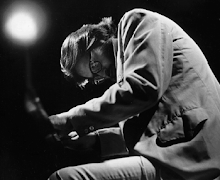
Between the arrhythmia and the blues
 In 1981, after relaunching himself into the hectic world of jazz (that he had stirred a cocktail), Miles Davis was feeling 100%. The Man With The Horn had worked well and it seemed that the next album, as it were, it would be easier to be designed and recorded. It was named We Want Miles and was recorded by the same musicians as the previous, with the addition of percussionist Mino Cinelu. It was followed by a tour that was developed mainly by Japan, and a series of albums (Decoy, You're Under Arrest, Aura ...) in which Miles doubt to continue with the stormy sound experiments of the past decade or to give a new turn of the screw.
  One of those albums, Star People (1982) reflects this internal raw war of Miles. The album is torn between the issues of stormy funk ("Come Get It", "Speak", "Star On Cicely") and the ballads ("It Gets Better", "Star People") in which moderation takes you back to that sound in the days when he was working with Gil Evans, with whom Miles had resumed their friendship during his disappeared years (1976-80). As the producer was Teo Macero, Evans goes virtually unnoticed, but he collaborated actively in the construction of the album, as we shall see.
 The process of creating Star People was not easy. Miles was not cured. That year, Cicely Tyson left the country and Miles, alone again, relapsed into a state of anxiety. He had left the cocaine, but returned to smoking (four packs a day) and drinking (more beer than we could imagine). When she could speak with Cicely, Miles could not move his fingers. He had suffered a stroke. Soon he could not move his arm or play the trumpet.
After months of acupuncture, diet and abstinence, lost almost all his hair, Miles is awakened one night and, despite wearing a cast on his arm, found that he could play. It was a renaissance in his own words.
 He did not want to waste time. He had spent seven years without appearing in Europe and every time he went was welcomed like a star. The success was assured and that was what he needed just at that moment: a popular heat to return the self-esteem. However, the press (and, by extension, the audience) had no idea about the episode of stroke, so nobody was prepared for the skeletal and ghostly figure of that Miles who appeared on stage in Stockholm, Copenhagen, Hamburg and Frankfurt. A producer who was going to record the concert in London (and making a film) startled when saw him. Called to his father-in-law, a doctor and psychiatrist, who examined Miles and reassured him saying he would play a bit the first night, just a little bit more the second and the third night at the Hammersmith Odeon he would be "unstoppable."
 Then came the album.
At that time, Miles only listens to pop music (Prince, Michael Jackson, Stevie Wonder ...), of trying to absorb, above all, the ability to reach wider audience. He wants to be back on the top again. Thus, returning to study, he changes his way of working. The unordered rehearsals that frightened the musicians now become conscientious sessions. Miles makes Gil Evans transcribe the solos played during the rehearsals: "Star on Cicely" is credited as a song composed by Miles, but it's part of a solo played by Mike Stern during a rehearsak; "It Gets Better" and "Speak" is inspired by a solo that John Scofield improvised in the studio. To capture the example, the most disordered track of the album is "Come Get It," which was recorded live, not in studio. Miles becomed a serious and organized musician.
Of course, improvisation is still an essential pillar of the music of Miles, as seen in the issues, but what interests me most about this album is the yawning gap that exists between the ballads and funk tracks. How Miles compose and arrange them differs substantially. "It Gets Better" is a blues with all the keys, while "Speak" is a storm of bad ideas striking funk sounds reminiscent of some issues of the era Prince. This huge gap between the fast tracks and the blues ones suggests a two-sided Miles, a dual being that really does not dare to choose between returning to the experimental arrhythmia of 70's or profiting from the newly embraced religion, built aseptic as pop. Maybe that's why each side gives 50% of the disk.
In a more clear way that We Want Miles, the album Star People marks what will be the latest style of Miles, riding between the remnants of his previous electronic experiments (in a more refined way) and the increasingly power silences (in line with that sound and affordable aseptic envy of pop).
Anecdotally, one might add that it was the first time that pictures of Miles (the hobby had helped him in the bad times) were used for a cover and the last time that Teo Macero was the producer.
Here you have "Star People", belonging to that half of the disc where Miles sounds like old times. It was recorded in Paris on September 20, 1986, and the group is different from the album:
This one is track 3, "Speak". It belongs to the other half of the album, which I do not know what theory supports old-Miles, surely the chaos:
Here you have "Star People", belonging to that half of the disc where Miles sounds like old times. It was recorded in Paris on September 20, 1986, and the group is different from the album:
This one is track 3, "Speak". It belongs to the other half of the album, which I do not know what theory supports old-Miles, surely the chaos:
_______ _______
* The top photo is Miles Davis 80. The author is K. Abe.
** The cover of Star People, with a picture of Miles.
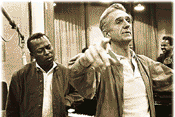
*** The bottom picture corresponds to Miles in 1981, the fateful year. I do not know the author.